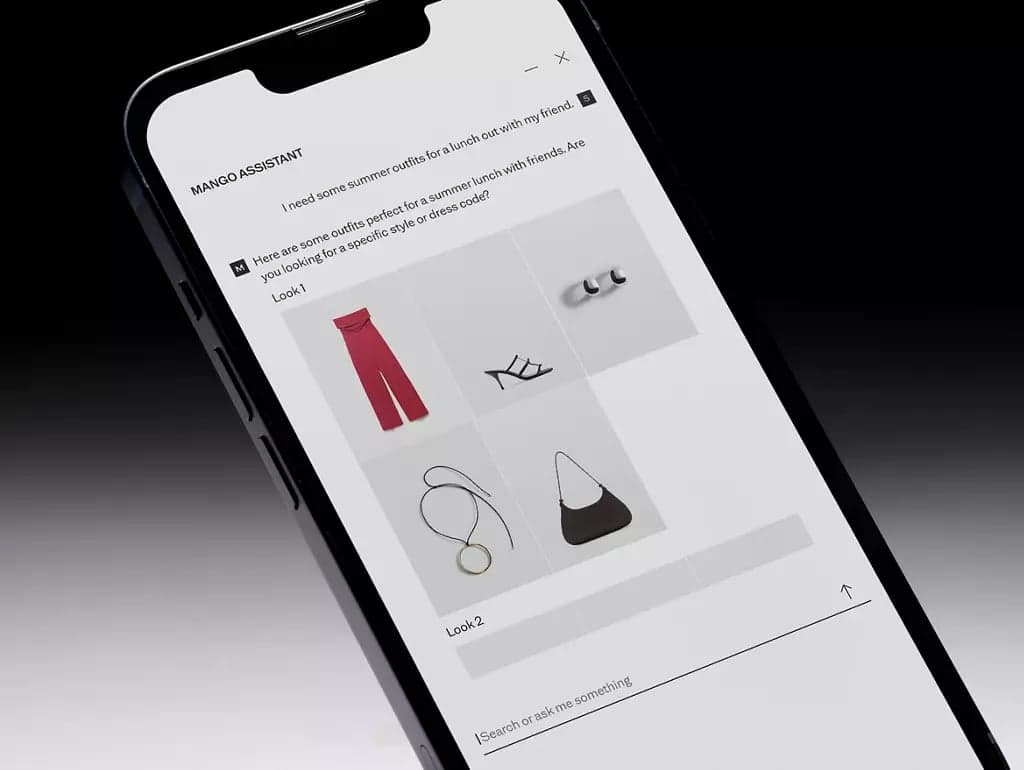
AI chatbot fatigue has already set in. Almost every digital product eventually gets its own chat window: banks, airlines, online stores, marketplaces. Now Mango has joined the list with Mango Stylist, an assistant that lets shoppers describe an occasion, point to an item they like, or ask for help building an outfit around it.

Mango Fashion Group
The generative AI part is not what makes this interesting. What matters is that Mango is trying to replace part of the usual e-commerce navigation with conversation. Instead of working through categories and filters, a shopper can ask for something to wear to dinner in Barcelona, ask what goes with a specific pair of trousers, or make an existing look less formal.
At that point, the system has to do much more than generate a convincing answer. It has to turn a vague human intention into actual products that fit the context, work together, and are still available to buy. That is where the chatbot ends and the engineering problem begins.
Traditional search runs out of road pretty quickly
Classic e-commerce search works well as long as the customer speaks the language of the catalog. A query like black linen trousers maps neatly to known attributes: category is trousers, color is black, material is linen. Search indexes and filters have been built around that model for years.
A request like “something for dinner in Barcelona, but not too dressed up” is different. A PIM probably does not have a field called good_for_dinner_in_barcelona=true, and there is no simple filter for “a little formal, but not overdressed.”
That is where semantic search comes in. Instead of matching exact words, the system has to connect the meaning of the request to products and style contexts. One common approach is to represent text and images as vectors and search for nearby items in the same latent space. In fashion, multimodal models such as CLIP and fashion-specific variants are useful because they can work across product metadata, text, and visual content at the same time.


Mango Fashion Group
But vector search only solves the first part. It can help find products that look or feel close to what the shopper described. It does not mean those products will make a good outfit.
Finding trousers is easy. Knowing what goes with them is not
If someone asks what to wear with a specific pair of trousers, nearest-neighbor search can return products with a similar color palette or aesthetic. That is not the same as actual compatibility.
Styling is a relationship problem. In an ideal setup, a fashion catalog starts to look something like a Fashion Knowledge Graph, where a product can be connected to other products through styled_with, to occasions through appropriate_for, and to silhouettes, collections, campaigns, seasons, and complete looks.
Then “what should I wear with these trousers?” becomes more than a similarity search. It becomes a traversal across relationships with different weights, meanings, and sources.
The problem is that fashion companies almost never have that graph waiting neatly in one place. Some information lives in the PIM or PLM. Styling guidelines may be sitting in PDFs. Campaign content is in a DAM. Visual merchandising decisions are captured in separate tools, while a lot of buyer knowledge still lives in people’s heads. Much of the most useful information was never created as structured data in the first place.


Mango Fashion Group
A stylist pairs a jacket with a pair of trousers for a shoot, visual merchandising repeats the combination on the homepage, marketing uses it again in a campaign, and customers later start buying the two pieces together. All of those events can potentially create an edge in the graph, but they carry very different weights.


Mango Fashion Group
That creates a cold-start problem. A new product may not have appeared in a campaign yet, nobody has bought it together with anything else, and there is no historical co-occurrence data to work with. In that case, the system has to lean more heavily on visual features, product metadata, and general collection rules.
The opposite problem is noise. Two products appearing together in a shoot does not automatically make them a universal match. The combination may have been chosen for one specific model, body shape, proportion, or campaign concept. A look that works perfectly in an editorial image may be a poor recommendation for a different shopper.
So the data problem is not simply collecting relationships. It is deciding which ones are meaningful. The team has to understand the source of each signal, its context, frequency, and level of trust. That is why “just feed the lookbooks to AI” is not really a solution. Implicit visual knowledge has to become explicit, usable relationships before it can support ranking.
In that architecture, the LLM is closer to an interface layer. It can help interpret the request and phrase the answer, but most of the real value sits in retrieval, graph traversal, and the quality of the enterprise data underneath.
Then real e-commerce shows up
Even a perfectly styled outfit is useless if half of it cannot be purchased. The system may find the ideal jacket for a pair of trousers, but if the shopper’s size is gone, the recommendation is effectively wrong. Stylist therefore cannot operate on a static catalog alone. Retrieval and ranking have to account for availability by market, channel, and size.
Business rules arrive immediately after that. A retailer may want to move inventory under pressure, support a seasonal sale, protect margin, or prioritize a new collection. Ranking stops being purely about aesthetics.
Retrieval may return a set of visually and semantically relevant products, and reranking can then consider styling compatibility, size availability, price, market, stock position, and business priority. Push commercial signals too hard and the Stylist starts to feel like a salesperson clearing slow-moving stock. Ignore them completely and it recommends beautiful products nobody can buy.
That is no longer a generative AI problem. It is a ranking problem with several competing objectives.
It also has to be fast
The more systems and rules involved in every answer, the more latency becomes a problem.
On an architecture diagram, the pipeline can look elegant: detect intent, run semantic retrieval, traverse product relationships, check inventory, apply business rules, rerank the candidates, and send the final set to an LLM for the response. The shopper only sees how long the dots keep blinking.
E-commerce search feels almost instant today. If a conversational interface needs six or eight seconds every time the user refines a request, filters start looking attractive again. A lot of the actual engineering work therefore sits in caching, precomputed relationships, fast inventory lookups, limiting retrieval steps, and knowing where an LLM is unnecessary.
Sometimes the best AI optimization is simply not calling AI when a normal lookup or precomputed ranking will do.
Stylist is also a stress test for the commerce architecture
Conversation makes data problems more visible than normal navigation. When a shopper moves manually between a category page, product page, recommendations, and stock availability, the boundaries between those systems are hidden by the UX. In chat, the shopper asks one question and expects one coherent answer.
If the PIM says one thing, the search index says another, the recommendation service is running on an older catalog, and inventory has already changed, the assistant has to reconcile those differences in real time. That makes products like Stylist a surprisingly good stress test for the underlying commerce architecture.
It also creates a richer kind of feedback. A query such as blue dress says very little. “I need a dress for a job interview, but I do not want to look corporate” contains an occasion, a formality level, and an aesthetic constraint. “I like this, but show me something cheaper” adds price sensitivity, while “the same thing without sleeves” gives a specific reason the previous option failed.
For search and recommendation teams, that is a much richer feedback loop. Conversation can reveal not only what shoppers clicked, but what they were actually trying to achieve.
Unified context matters more than another channel
The connection between Stylist, Instagram, and customer service only becomes technically interesting if the context survives across channels.
If a shopper starts in Instagram DMs, chooses a few products, and then moves to the website, the web session should understand which outfit they were discussing. That turns into a problem around session state, identity resolution, and preference context: linking a social session to a web session, preserving selected products, inferred preferences, and the state of the conversation.
That matters for marketing because Instagram often sits at the beginning of fashion discovery. If all context disappears as soon as the shopper lands on the website, the conversational layer does very little to shorten the funnel. If the selected look and session state carry over, social becomes part of the same shopping session rather than just another traffic source.
What matters next
The real question is whether Stylist becomes an interface over Mango’s commerce and enterprise data, or stays as a separate AI feature beside the actual store.
Ask Ralph already showed how quickly this pattern can look finished from the outside: a chat window, a few looks, a path to purchase. The harder test is the same one every time. If Stylist can work with live inventory, product data, recommendations, and customer context as one connected system, it becomes part of the architecture.
If not, it ends up as a polished demo and another isolated AI PoC.