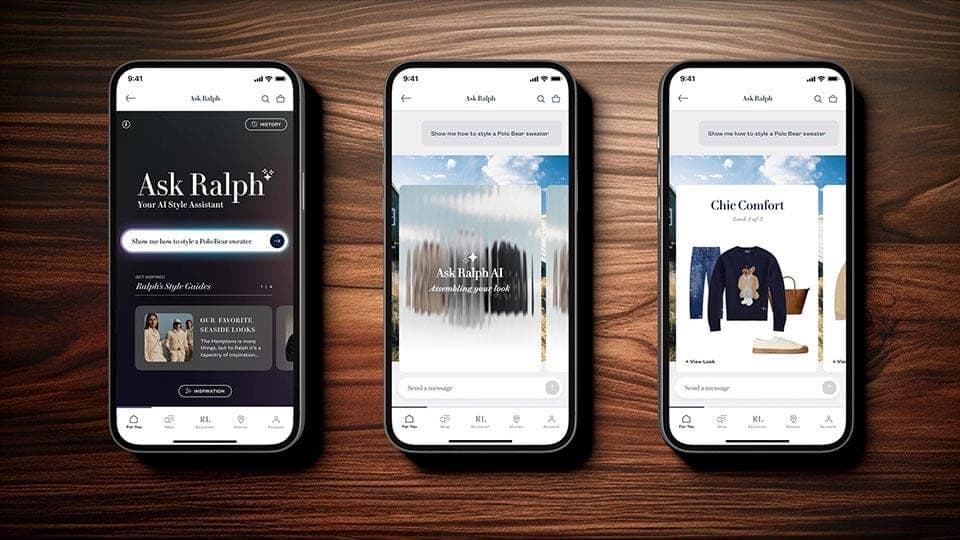
Remember those scenes in Black Mirror where an ordinary surface suddenly becomes an interface—one that knows more about you than you know about yourself?
That was the promise of the smart mirror.
You walk up to it, and it already knows who you are. It recognizes your face, opens your digital closet, scans your body, checks the weather, and suggests an outfit for whatever you have planned that night. You turn slightly, and your reflection changes with you. A black blazer becomes white. Sneakers turn into boots. A coat that is not even stocked in the store appears over your T-shirt.
The mirror does not just show you clothes. It understands fit. It knows where the fabric will pull, which size is more likely to work, and whether the pants are too long. It can build the rest of the outfit, add accessories, and place the order while you are still looking at yourself.
That was the smart mirror fashion promised us.
Science fiction had been preparing us for it for decades. In Minority Report, stores and advertising displays recognized people and addressed them by name. In Iron Man, digital objects sat naturally inside the physical world, as if interfaces no longer needed screens. In Blade Runner 2049, synthetic images looked almost like living bodies. Even Clueless, hardly science fiction, showed a computerized closet in 1995 that could cycle through clothes and assemble an outfit.
The future seemed obvious: walls, glass, and mirrors would understand us and reshape the world around us.
Fashion retail tried to build that future.
What it produced was a mirror with a few buttons.
In the early 2010s, brands began installing large touchscreens, RFID readers, and cameras inside fitting rooms. The systems could identify the products a customer carried inside, display other sizes and colors, change the lighting, and summon a sales associate.
They called it a smart mirror.
It was nowhere close to the fictional version that understood bodies, fabrics, and fit. The first generation knew almost nothing about the customer. It simply moved the product catalog from a phone onto the fitting-room wall.
That was still enough for the industry to declare a new era.
A few years later, the first wave of smart mirrors had nearly disappeared. Then generative AI arrived and learned to change not the menu beside the reflection, but the reflection itself. For the first time, a mirror could show someone wearing clothes they had never put on.
The dead product appeared to have a second life.
But there was no miracle.
Smart mirrors became much smarter.
They did not become more necessary.
The store of the future started with a screen
In 2014, Rebecca Minkoff and eBay opened a tech-heavy store in New York’s SoHo neighborhood. Customers could browse products on a large mirrored display and send items to a fitting room. RFID tags identified the clothes they brought inside, while the touchscreen mirror displayed available sizes and colors, suggested additional products, adjusted the lighting, and contacted store staff.
Around the same time, Nordstrom tested interactive fitting rooms developed with eBay. The mirrors became touch displays where shoppers could look for other sizes and colors or request help from an associate. The scale of the rollout already revealed what the technology really was: not a new infrastructure layer for the entire retail chain, but an experiment inside a few departments at a handful of stores.
Ralph Lauren installed connected fitting rooms at its Fifth Avenue flagship. Oak Labs mirrors used RFID to identify the products inside the room, display available variants, recommend other items, and send customer requests to sales associates.
It looked as if the physical store had finally received the interface of an online shop.
Brands and vendors later reported high interaction rates. These numbers looked excellent in presentations about the future of retail, but engagement was easy to confuse with value. A shopper could tap the mirror out of curiosity, switch the lighting a few times, browse another color, call an associate, take a photo, and leave without buying anything.
To the innovation team, that was engagement.
To the CFO, it was expensive hardware with unclear returns.
A pattern emerged that smart mirrors would repeat for years. A brand installed a few units in a prestigious location, invited the press, produced a polished video, published an impressive interaction metric, and called the pilot the beginning of a new era.
Then the technology rarely moved beyond the pilot.
They were smart mostly in press releases
The first smart mirrors benefited from a generous definition of “smart.” Inside was a screen, an RFID reader, a product catalog, and a handful of buttons. Some added lighting controls, short video recording, or product recommendations.
In practice, it was a large tablet embedded in a fitting-room wall.
The mirror did not know whether a garment fit well. It could not see that a jacket pulled across the shoulders or that a pair of pants restricted movement. It could not feel the fabric, tell whether a sweater would itch, or predict what the garment would look like after five washes. It displayed information next to the shopper while knowing very little about the shopper.
Most of its features already had simpler alternatives. A sales associate could bring another size. A customer could compare two outfits with a phone camera. Another color was often hanging nearby or available on the website. A video could show the back of an outfit.
Customers were asked to learn a new interface to save a few steps across the store.
That was enough for a demo.
It was not enough to create a new habit.
The product looked especially weak next to the smartphone. The phone already belonged to the customer. It knew their history, had a camera and internet connection, ran brand apps, compared prices, sent pictures to friends, and continued working after the customer left the store.
The smart mirror offered a more limited interface on someone else’s device, bolted to a wall.
The startups that sold a screen as a revolution
A small retail-tech ecosystem quickly formed around smart mirrors. These startups promised to turn the fitting room from a blind spot into a new source of data.
Retailers usually knew what a customer bought. They knew much less about what happened before the purchase: which items entered the fitting room, which sizes the customer requested, what they tried on but abandoned, and which products they attempted to combine.
Oak Labs became one of the best-known companies in this first wave. Its Oak Mirror combined RFID, a product catalog, recommendations, and communication with store employees. The startup raised funding and briefly looked like the future operating system of physical retail.
Mass adoption never arrived.
In 2018, kiosk manufacturer Zivelo acquired Oak Labs. By that point, the most valuable part of the company was no longer the fitting-room mirror. It was OakOS, a software platform for public screens and self-service terminals.
That is a fitting obituary for the first smart-mirror era. The mirror disappeared. The kiosk software survived.
People use public kiosks not because they want to experience the future. They use them because they need to order food, check in, print a ticket, or pay.
MemoMi followed a different but equally revealing path. Its Memory Mirror was used across fashion, beauty, accessories, and eyewear. In 2022, Walmart acquired the company. Walmart was primarily interested in virtual eyewear try-on and contactless digital measurements—not in futuristic fashion fitting rooms.
The startup survived, but the mirror once again stopped being the center of the product. The value moved into computer vision, measurement, augmented reality, and software that could work in stores, on websites, and at home.
These acquisitions are often described as successful exits.
For smart mirrors, they looked more like professionally managed funerals. Investors found a way out, the technology found a new owner, and the idea of rebuilding fitting rooms at scale quietly disappeared without anyone formally admitting that it had failed.
Every Major Brand Tried It. Almost None Went Further.
Smart mirrors were not ignored by the industry’s biggest companies. Quite the opposite.
Ralph Lauren installed connected fitting rooms in a major flagship. Nordstrom kept its experiments limited to selected stores. H&M Group later piloted smart mirrors in U.S. COS locations. The systems recognized products brought into the fitting room, allowed customers to request additional items, and could recommend related products.
Uniqlo demonstrated a Magic Mirror that let a shopper put on one item and switch its color on the screen. It was an excellent press story and a convincing augmented-reality demonstration. It was not the beginning of a global fitting-room transformation.
This became the standard form of smart-mirror deployment: a few devices inside a flagship, an innovation lab, a pop-up, or a tourist-heavy location.
Those were places where an expensive experiment could be justified even without measurable sales growth. On Fifth Avenue, the mirror was not only a retail tool. It was part of the set design. It attracted journalists, generated social content, and helped the brand look as though it already lived in the future. Fashion Week pop-ups still stage the same kind of demo; watching one is useful only if you ask whether it is production or theater.
The technology rarely reached ordinary stores.
Not because it did absolutely nothing. It performed the role for which it was genuinely well suited: getting attention, entertaining a customer for a few minutes, and producing a strong promotional video.
It was a decent marketing attraction.
It was poor retail infrastructure.
When a technology genuinely changes a business, it stops being a pilot and becomes a standard. Point-of-sale systems do not exist only in flagships. RFID is not installed for a press release. Inventory systems are not presented to journalists as temporary experiments.
Smart mirrors remained in the category of technologies brands loved to demonstrate but did not want to scale.
Beauty found a better use for the mirror
Sephora and MAC Cosmetics also experimented with virtual mirrors, but beauty turned out to be a more natural environment for the technology. A system could track the face and apply different lipstick, eye shadow, or complexion shades in real time.

The value proposition was clearer. A shopper did not need to apply and remove ten different products to compare ten colors. A camera could render the shade reasonably well, and an error was less consequential than showing the wrong fit for a jacket.
But even in beauty, the technology eventually moved away from physical mirrors and into websites, apps, and smartphone cameras. Virtual try-on became a software feature that could run on almost any device rather than a dedicated piece of hardware inside a store.
Beauty did not prove that smart mirrors were a viable new equipment category.
It proved that virtual try-on could be a viable software capability.
That distinction matters.
Deepfake technology gave the mirror a second life
The first generation of smart mirrors did not create a new reflection. It placed an interface on top of the old one.
Computer vision and generative imaging changed that.
Pose estimation learned to identify the position of the arms, shoulders, and torso. Human parsing and segmentation separated the body, background, and clothing. Generative inpainting could remove part of the original image and fill it with something new. GANs, followed by diffusion models, made synthetic images of people dramatically more realistic.
What the public broadly calls deepfake technology was only the most visible part of this wave. The same building blocks—identity preservation, image editing, missing-region generation, and realistic video synthesis—could also be used for virtual try-on.
For smart mirrors, this looked like resurrection.
The old mirror could display a picture of a red jacket next to the shopper. The new mirror could attempt to show the shopper wearing the red jacket. The old product was a catalog. The new one was a wardrobe deepfake.
A camera captured the customer. The system estimated the body position, removed or covered the original clothing, and generated a new image that tried to preserve the face, body, and pose while replacing the garment.
For the first time, the entire product could be explained in one sentence:
See yourself in the item without putting it on.
This was no longer a lighting control, a call button, or a product card beside the reflection.
It looked like an actual technological breakthrough.
At least in the demo.
The second wave had real companies too
The second wave did not consist only of research papers and speculative demos. It had major companies, commercial products, and real budgets.
The difference was that these companies were no longer selling an RFID mirror. They were selling generative virtual try-on: combine an image of a person with an image of a specific product and synthesize a believable result.
Google launched Virtual Try-On in Shopping. The first version displayed clothing on models with different body types and sizes. The company later moved toward letting users try products on their own photos. This was far closer to the original smart-mirror promise: not a product card next to the person, but a newly generated image of that person.
But the mirror itself disappeared.
Google placed virtual try-on where the customer already was: in Search, Shopping, and on the customer’s own screen.
Zalando took a different approach, experimenting with virtual fitting rooms based on 3D avatars. Customers entered body measurements or created a digital representation of themselves, then used it to estimate silhouette and fit for selected categories. Google approached the problem through photorealistic generation. Zalando approached it through a more structured model of the body.
Neither made a physical mirror the center of the experience.
Snap tried to bring the technology back into the store with AR Mirrors as part of its ARES retail platform. The displays let customers try products virtually, control the interface with gestures, and create content in the store. Early examples included Nike and Men’s Wearhouse.
But the old pattern returned almost unchanged: flagship location, impressive camera, a few digital outfits, and a video designed for social media. Even the product logic emphasized entertainment, content creation, and engagement as much as actual purchasing.
Wannaby built AR try-on for shoes, bags, and accessories. Farfetch acquired the startup in 2022, and the technology later changed hands again. That path is revealing too. Virtual try-on found commercial value in product categories that are easier to anchor to a foot, face, hand, or wrist than a complex garment is to fit accurately across an entire moving body.
The second wave proved several things.
Google showed that generative try-on could live inside search.
Zalando showed that a 3D avatar could help visualize body shape and sizing.
Snap showed that an AR mirror could be a high-impact element inside a store.
Wannaby showed that virtual try-on could work for selected product categories as a reusable software layer.
None of them proved that fashion retail needed a new standard for physical mirrors.
AI revived virtual try-on.
The smart mirror remained just one possible screen on which to display it.
Undressing is easier than redressing
The gap between impressive image editing and actual virtual try-on becomes obvious when you look at what generative models can already do to the human body.
Removing an object from a photo is relatively straightforward. A model receives a mask, deletes the selected area, and fills it with pixels that look plausible in the surrounding context. That is why there are so many tools for object removal, local inpainting, clothing replacement, and unrestricted editing of human images.
Put bluntly, it is easier for a neural network to undress someone than to dress them properly.
In the first case, the model only needs to fill the empty region convincingly. It does not need to preserve the construction of a specific product, respect its size, seams, sleeve length, pocket placement, or physical interaction with the body.
Redressing someone requires several difficult tasks at once: removing the original garment, preserving the person’s identity and anatomy, transferring a specific new product, maintaining its details, adapting it to the pose, and generating a believable deformation of the fabric.
There are now plenty of models that can do this convincingly on a carefully selected still image.
Far fewer can do it accurately, consistently, and for an arbitrary product.
Almost none can do it reliably while the person is moving.
Apply image-based try-on independently to every frame of a video, and the garment begins to develop a life of its own. Prints slide around. Buttons jump. Sleeves change length. Folds appear and disappear. Edges flicker.
That is why video virtual try-on treats temporal consistency as a core problem in its own right. The model must not only create a good frame. It must remember what the garment looked like before and preserve its geometry as the body moves, lighting changes, and hands or hair temporarily cover parts of the clothing.
These levels are easy to confuse in a polished demo.
Removing clothing is a generative editing problem.
Putting on a specific garment is a product-preservation, anatomy, and geometry problem.
Keeping that garment stable on a moving body is a spatiotemporal modeling problem.
Making it move physically correctly is a material-simulation problem.
Several generations of technology separate those tasks.
A deepfake is not a fitting
The central strength of generative AI is also its central weakness.
A generative model must create a convincing image.
A fitting must provide accurate information about a physical product.
Those are not the same job.
Most virtual try-on systems are strongest at image-to-image generation. They receive a two-dimensional image of a person and a two-dimensional image of a garment, then generate a plausible combination at the pixel level. Pose estimation, human parsing, and segmentation help locate the arms, torso, and existing clothes, but the output is still an image reconstruction—not a physical simulation.
When the model does not have enough information, it does not stop and tell the user that it is uncertain. It fills the gap. It invents folds, guesses how the fabric should fall, cleans up awkward regions, and may produce a silhouette that is more flattering than reality.
For a deepfake system, that is success. The viewer believed the image.
For fashion retail, it can be a false promise. The shopper believed something the physical product never guaranteed.
NeRF, 3D Gaussian Splatting, and other 3D reconstruction methods do not automatically solve this problem. They can help recover body geometry and scene appearance, but they do not know how a specific material should behave on a specific person.
Accurate fitting requires more than a diffusion model and a good camera. It requires a physics engine capable of cloth simulation and drape analysis. That engine must understand fabric weight in GSM, stiffness, thickness, friction, weave direction, elastane stretch, seam behavior, and the material’s response to movement.
The system also needs an accurate 3D representation of the body underneath the clothes—not just a silhouette reconstructed from one camera frame, but volume, posture, joint positions, and how the body changes as it moves. In the ideal version, that would mean a full 3D mesh or voxel representation synchronized with a digital twin of the garment.
Most retailers do not even have a useful digital twin of the product.
Their catalog contains photographs, fiber composition, a size chart, and perhaps a few basic measurements. It usually does not include a production-ready 3D mesh, fabric deformation parameters, friction coefficients, stiffness maps, exact seam geometry, or physical material-test results.
The model is being asked to calculate fit without receiving a complete body, a physical garment model, or the material properties of the fabric.
Without those inputs, a diffusion model does not calculate fit.
It makes a visual guess.
AI can show a jacket following the body perfectly without calculating the tension across the shoulders. It can render a loose dress without knowing whether it will actually be loose in the selected size. It can preserve the general print while changing the sleeve length, pocket placement, or spacing between buttons.
It can draw convincing folds.
It does not know where those folds should physically occur.
You cannot stretch fabric physics over a generated image and call it a fitting.
Bad graphics look like a toy. Good graphics look like a promise.
But the image cannot tell you whether the collar rubs, the fabric itches, the sleeves restrict movement, or the pants pull when you sit down.
AI sees pixels and statistical relationships between them.
The customer buys materials, construction, and the way they interact with a real body.
One to three seconds per frame is not real time
Even if we ignore fabric physics, the compute problem remains.
A diffusion model does not normally create an image in a single pass. It begins with noise and repeatedly refines the result through a sequence of denoising steps. The more steps it uses, the higher the resolution, and the more complex the conditioning on the person, pose, and garment, the more GPU time each frame requires.
Modern image diffusion without aggressive optimization can still take many seconds per image. Video diffusion is heavier because it must generate a sequence while preserving consistency across frames.
Adobe and NVIDIA used TensorRT, FP8 quantization, and Hopper GPUs to reduce diffusion latency by roughly 60% and total cost of ownership by nearly 40%. The work involved ONNX export, BF16/FP8 mixed precision, and detailed profiling of computational bottlenecks.
With fast sampling, fewer denoising steps, model distillation, specialized virtual try-on pipelines, cached garment features, and highly optimized node setups, it is possible to bring a frame down to roughly one to three seconds on a powerful GPU.
That can be acceptable for an online catalog. A shopper uploads a photo, waits briefly, and receives an image.
For a mirror, it is nowhere near real time.
Standard video runs at 24 to 30 frames per second. That leaves roughly 33 to 42 milliseconds to create each frame. One second per frame is about 24 to 30 times too slow. Three seconds per frame is roughly 72 to 90 times too slow.
The customer turns now.
The jacket turns two seconds later.
That is not a reflection. It is a laggy video call with your own digital twin.
This is why many products marketed as real-time AI mirrors do not run full diffusion generation on every frame. They use lighter AR overlays, image warping, prebuilt assets, reduced resolution, keyframe processing, or a hybrid pipeline that generates occasional frames and propagates the result through time.
There are really three performance tiers.
A few seconds can produce a strong still image.
One to three seconds per frame can produce a slow demo or a nearly interactive prototype.
A true mirror needs stable output within tens of milliseconds—without losing the face, the product details, temporal consistency, or physical plausibility.
Between an impressive AI demo and a real reflection lies more than fabric physics.
There are also several orders of magnitude of compute performance.
The Technology Improved. The Economics Did Not.
Even a perfect image would not solve the core problem of the smart mirror: it is an expensive way to deliver a small convenience.
The mirror must connect to the product catalog, size data, prices, inventory, RFID infrastructure, employee applications, and sometimes the customer profile. These systems need near-real-time synchronization. Otherwise, the mirror will display a size that is not actually available, recommend an item that has already sold, or send an associate to search for a garment sitting in someone else’s fitting room.
From a data-engineering perspective, this is no longer a mirror.
It is a distributed integration platform—the same class of work as the quiet systems that already move a coat from PLM to the warehouse, only installed where customers can see it fail.
RFID events must map correctly to SKUs. Inventory must stay synchronized across the POS, ERP, OMS, and the store’s local systems. Product master data must contain correct sizes, colors, images, and relationships between product variants. Events generated by the mirror must reach the analytics platform without treating a curious tap as a real purchase intention. When those identifiers disagree, the same product can wear ten different IDs before anyone notices.
If one part of that chain fails, the mirror begins to lie.
It can show that a size is in stock because the damaged item has not yet been written off. It can recommend an outfit whose missing piece is still packed in a box in the stockroom. It can send a request to an associate without knowing that the associate is already helping three other customers.
Then come the physical problems. The camera must work under inconsistent lighting. The display must survive constant use. The connection must remain stable. The interface cannot freeze. The hardware cannot overheat. Every device must be installed, updated, cleaned, repaired, secured, and monitored.
Across hundreds of stores and thousands of fitting rooms, a pilot becomes its own technology estate: device management, observability, model deployment, integration support, data-quality controls, and operational ownership.
All of that could be justified if the mirror clearly increased sales.
Proving that is difficult.
A customer can play with colors, generate several looks, request another size, and still leave without buying anything.
In a presentation, that is engagement.
In a P&L, it may be nothing.
The analytics are harder than they look too. To prove impact, the retailer must separate the mirror’s effect from flagship-store traffic, associate performance, promotions, assortment, seasonality, and tourism. That requires control groups, credible attribution, and a long enough observation period.
A high interaction rate does not prove higher conversion.
Higher conversion in one experimental flagship does not prove the technology will pay for itself across a thousand ordinary stores.
AI improved the image.
It did not make the hardware cheaper, the data cleaner, the integrations simpler, or the business case clearer.
Maybe retailers never learned how to use them
The technology was not the only problem. Most smart-mirror pilots tried to insert a new digital product into a store that continued operating exactly as before.
When a shopper taps “bring me another size,” an employee must see the request immediately, find the item, and deliver it to the correct fitting room. If the mirror recommends a complete outfit, every item needs to be available at that exact location. If the system collects fitting-room data, someone must use it to change the assortment, merchandising, or staffing model.
Without those operating processes, the mirror becomes a polished interface on top of the same old store.
The technology promises instant service but depends on a sales associate covering several fitting rooms. It promises exact inventory but reads from systems where an item may technically be “in store” while physically sitting at the register, in a box, or inside another customer’s room. It promises personalization but often does not even know who is standing in front of it.
You could argue that retailers simply never learned how to use smart mirrors.
That is also a product problem.
Good technology has to fit into a real operating model. If the store must be rebuilt before the product can work, the store is not the only thing at fault.
Stores Did Not Die. Mirrors Lost the Budget Fight.
It is tempting to explain the failure of smart mirrors as part of the death of physical retail. Customers moved online, malls emptied out, and brands stopped investing in stores of the future.
But stores did not disappear.
People still go to stores to touch fabric, see colors in real life, try on shoes, check a size, and take the product home immediately. A physical location still functions as a sales channel, a brand advertisement, a pickup point, and a place to discover products.
What changed was the standard for retail technology.
Retailers became more skeptical of products that looked futuristic but did not reduce costs or increase sales. Instead of installing theatrical screens, they invested in less glamorous systems: accurate inventory, RFID, mobile checkout, workforce management, analytics, logistics, and faster pickup for online orders. Turn those quieter tools off for a day, and the office feels the dependence immediately—even when no mirror is involved.
The smart mirror did not lose because the store died.
It lost the internal competition for retail investment.
When the choice is between a fitting-room screen and a system that prevents lost inventory, reduces checkout lines, or improves shelf replenishment, the mirror is rarely the priority.
Virtual try-on was installed in the wrong place
The idea of a virtual reflection was not necessarily bad.
The chosen location may have been.
Inside a store, the customer can already pick up the garment and try it on physically. That is where virtual try-on offers the least value.
It makes far more sense at home, where the product is not available. On a website, it can help a shopper evaluate an unfamiliar item. In an app, it can compare alternatives. On social media, it can connect inspiration directly to shopping. On a phone, it can use the customer’s own photos, order history, and saved measurements.
The paradox is almost comical.
A customer travels to the store, finds the product, reaches the fitting room, and stands a few seconds away from trying on the real garment.
That is the exact moment the industry offers a virtual fitting.
Generative AI has genuinely improved virtual try-on. It recognizes bodies more accurately, creates more realistic images, and generates virtual looks without a full photo shoot.
Most of that value is more useful online.
A shopper can upload a photo at home, try on an item from a product page, compare products across brands, save the image, send it to a friend, and return to the purchase later.
None of that requires traveling to a store, entering a specific fitting room, and standing in front of an expensive display.
The technology that was supposed to save the smart mirror turned out to be more useful without it.
What is dead may stay dead
No single problem killed the smart mirror. It was the combination.
The technology was not accurate enough. The benefit was too small. The integrations were too complicated. The equipment was too expensive. Store operations were too slow. Customer habits were too stable. The smartphone was already good enough.
AI improved the most visible part of the product. The mirror could finally generate a new version of the person instead of displaying a catalog beside the reflection.
But AI did not make the hardware cheaper. It did not fix inventory data. It did not speed up store employees. It did not prove incremental revenue. It did not add fabric stiffness, drape behavior, and seam mechanics to the product master. It did not turn catalog photography into a physically accurate digital twin.
It learned to remove clothing convincingly.
It learned to dress someone beautifully in a still image—sometimes.
It still struggles to keep that clothing stable while the person moves.
Google, Zalando, Snap, and Wannaby proved that virtual try-on can exist in search, apps, augmented reality, and selected product categories.
They did not prove that fashion retail needs a new standard for physical mirrors.
And no one has convincingly answered the retailer’s most important question:
How much incremental revenue will each installed mirror generate?
That is why the miracle never happened.
Smart mirrors became smarter.
The equation did not change.
Virtual try-on will probably survive. It will keep expanding across websites, apps, advertising, and social platforms. Generative models will become more accurate. Images will become more realistic. Product details will improve.
That does not mean the smart mirror is coming back.
It may mean the opposite.
The better AI becomes, the less it needs a dedicated physical screen inside a store.
The real product was never the mirror.
The real product was the ability to see yourself wearing something else.
Retail-tech startups first tried to attach that ability to an expensive object on a fitting-room wall. AI briefly convinced the industry that the object could be resurrected.
Instead, AI demonstrated that the object was unnecessary.
The industry made the same mistake twice: first by selling a tablet in a mirror frame, then by selling a generative deepfake. Both times, it confused a polished promotional video with a solution to a business problem.
The neural network learned to generate pixels.
It did not learn the physics of patternmaking, construction, and fabric.
Virtual try-on survived.
The touchscreen on the fitting-room wall did not.